

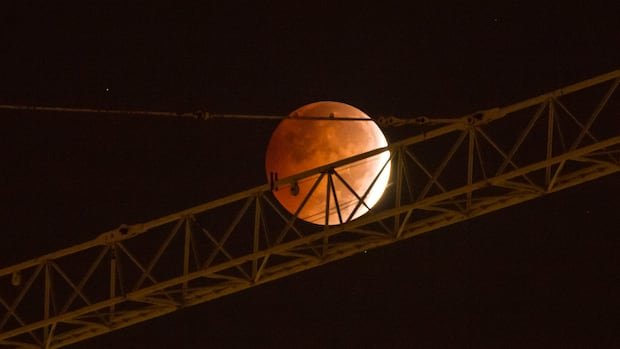

On the night of August 27-28, a deep partial lunar eclipse will be visible nationwide. This event follows the recent total solar eclipse seen in Iceland, Spain, and a portion of Portugal about two weeks ago.
Lunar eclipses occur when the moon passes through Earth’s shadow, known as the umbra, after passing through the outer shadow, the penumbra. The upcoming partial eclipse will have a significant 93% coverage at its peak, making it a remarkable celestial event.
Most areas in Canada will have the opportunity to witness the entire eclipse duration, while Western Canada will catch a glimpse of the partial eclipse as the moon rises. Unlike solar eclipses, no protective eyewear is needed to observe a lunar eclipse, making it a safe and accessible event for all sky gazers.
The eclipse will commence as the moon enters Earth’s penumbra around 10 p.m. ET, with the visible phase starting at 10:33 p.m. ET on August 27 and concluding at 1:52 a.m. on August 28. The eclipse’s most profound moment, with nearly the entire moon darkened, will occur at 12:13 a.m.
This lunar eclipse is part of a series of astronomical events happening this month. According to Elaina Hyde, director of the Allan I. Carswell Observatory at York University, August has been an exciting month for celestial phenomena, including a partial solar eclipse and the Perseid meteor shower.
Regarding the eclipse’s appearance, Hyde mentioned that while it won’t transform into a “blood moon” due to its partial nature, observers in Canada may witness a reddish hue. The beauty of lunar eclipses lies in their visibility to the naked eye, and enthusiasts can capture stunning images using binoculars, telescopes, or even a smartphone with a good night mode.
Get ready to mark your calendars and enjoy this captivating celestial spectacle without the need for specialized equipment.