

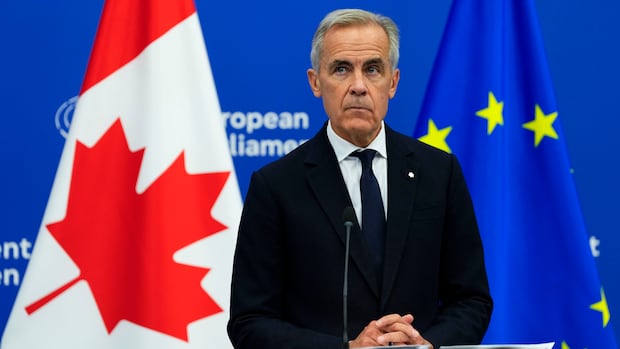

Officials from the European Union have indicated that the specifics and official designation of Canada’s potential associate membership with the EU are still under internal discussion. Nonetheless, the 27 member states are agreed on their desire for the “closest possible association” with Canada.
This week, Canada is set to host the EU for a summit in Montreal, where both parties are anticipated to unveil new agreements across several significant areas, including trade, security, and technology.
A senior EU official remarked on Tuesday morning during a press briefing in Brussels that this year’s summit stands as one of the “most important summits the European Union has ever held.”
“We are forging a partnership that approaches membership more closely than any previous efforts,” the official added.
Associate membership? Strategic alliance? Whatever you want to call it, Prime Minister Mark Carney’s push for deeper ties to Europe are well underway. The CBC’s Marina von Stackelberg breaks down some of the changes Canadians could see should Ottawa and Brussels formalize the agreement.
However, officials emphasized that this process is in its early stages.
“We are in uncharted territory. The work that lies ahead will be crucial between now and the next summit,” they noted, which is projected to take place in 2027.
Some officials acknowledged that certain member states are curious about what Canada’s new role will entail.
“However, I can confirm that there is no doubt among member states regarding their ambitions for this relationship,” an official stated.
Carney states summit initiates a year of discussions
Last month, European Commission President Ursula von der Leyen surprised many by revealing that the EU would begin the process of designating Canada as its first “associate member,” a status that does not currently exist within the bloc.
Prime Minister Mark Carney responded the following day during a speech at the European Parliament, expressing that Canada embraced “the ambition” of associate membership and later indicated to reporters that the essence of the relationship was more significant than the title.
On Tuesday in Ottawa, as he arrived for a cabinet meeting, Carney reiterated this perspective, indicating that the two-day summit beginning Thursday would act as a launchpad for formal discussions and negotiations over the coming year.
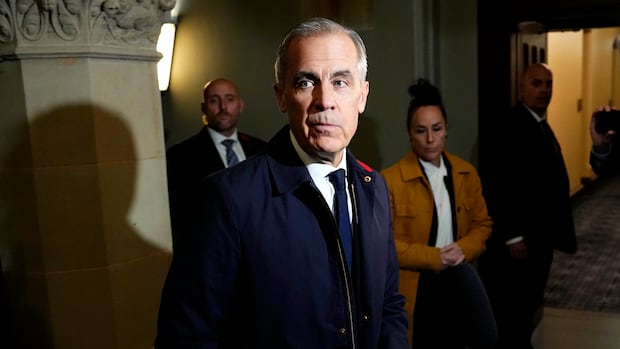
Prime Minister Mark Carney emphasizes that what ‘matters’ at the upcoming EU summit in Montreal is ‘Canada as a whole becoming a more independent, more sovereign nation so we can live our lives as we choose.’
“The positive aspect is that specific titles or terminology are not of great importance,” Carney remarked.
“What truly matters is the positive impact it will have on the lives of Canadians and the overall independence and sovereignty of Canada, allowing us to live according to our choices.”
Associate membership would be a distinct arrangement for Canada
There remain numerous uncertainties regarding what associate membership would demand from Canada and the implications for other European nations that have sought EU membership for years.
Officials noted on Tuesday that this type of associate membership would be tailored specifically for Canada.
“We are at the beginning of a journey, so let us not rush to define the extent of our progress,” they commented.
-
Far right gains ground in Europe as Canada pivots from Trump to EU
-
PQ accuses Ottawa of muzzling Quebec during upcoming Canada-EU summit
Officials did not disclose whether any other countries have approached the EU about establishing a similar relationship as Canada’s.
Carney has consistently reaffirmed that Canada does not aim for full EU membership, often describing the enhanced partnership as a “strategic alliance.”
The Prime Minister has been actively pursuing stronger diplomatic and trade relations with various nations, particularly in Europe, as the relationship between the U.S. and Canada continues to face challenges due to the trade conflict, characterized by escalating tariffs from U.S. President Donald Trump and ongoing threats to annex Canada.
The EU ranks as Canada’s second-largest global trading partner after the United States, with trade amounting to $178 billion last year.
Europeans have extensive agenda for closer cooperation
During Tuesday’s briefing, senior officials outlined a variety of subjects where Europe seeks to enhance collaboration with Canada, several of which they aim to finalize at the Montreal summit.
One proposal includes an agreement between Canada and the European Investment Bank that would enable the EU to finance critical mineral projects in Canada.
Additionally, negotiations are nearing completion on a revised EU-Canada competition agreement aimed at assisting authorities on both sides of the Atlantic in combating anti-competitive practices.
Regarding energy, EU officials discussed a long-term joint study assessing the feasibility of exporting natural gas from Canada’s East Coast to Europe. There is optimism for collaborative efforts between Canada and the EU to stockpile critical minerals and coordinate more effectively on nuclear research and development.
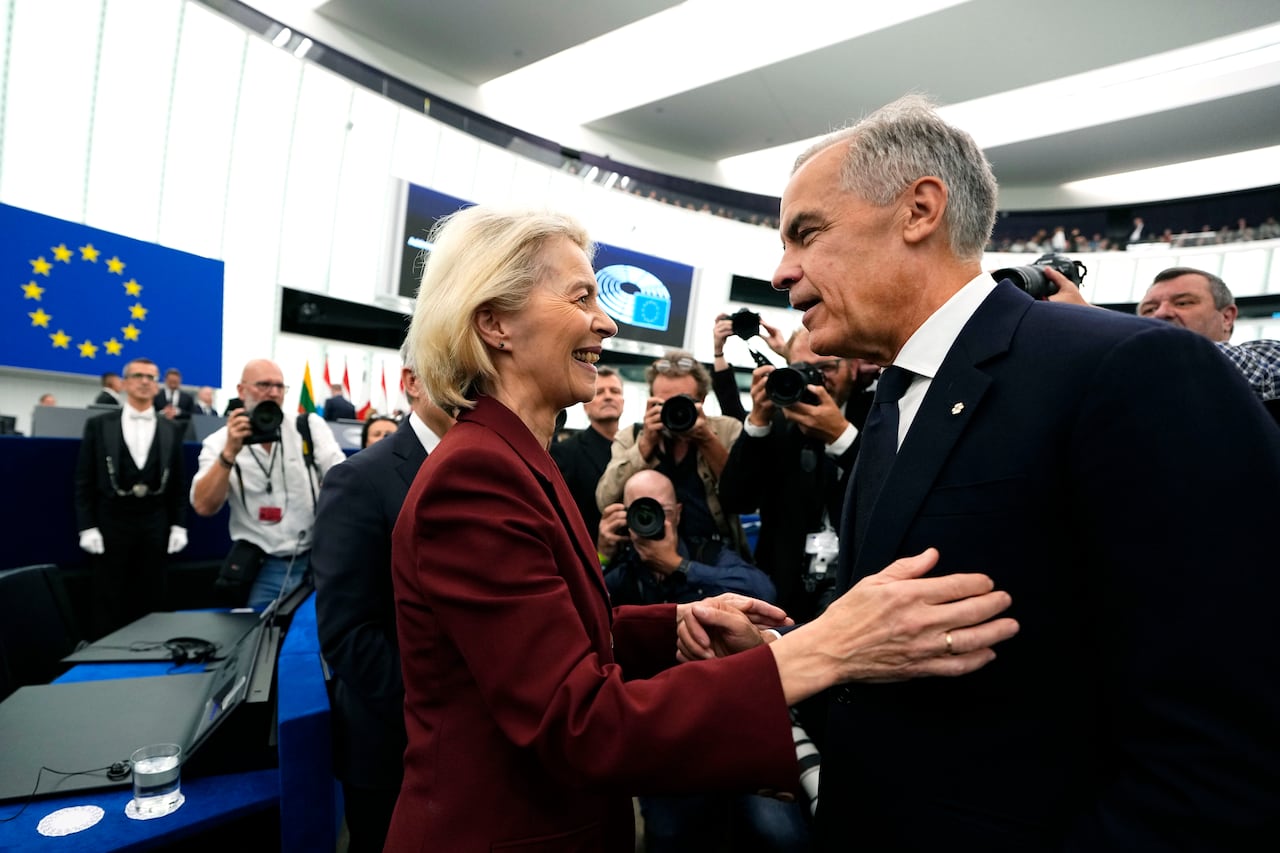
Carney is welcomed by European Commission President Ursula von der Leyen upon his arrival to speak at the European Parliament in September. The two are set to meet again in Montreal this week. (Justin Tang/The Canadian Press)
In the realm of technology, the EU aims to grant Canadian researchers and businesses access to its supercomputing facilities for studies in areas such as Alzheimer’s, AI, and beyond. Furthermore, Europe is amenable to including Canada in its satellite initiatives.
They aspire to establish more joint policies between the EU and Canada, which would involve regular discussions among lawmakers concerning climate, energy, artificial intelligence, innovation security, and other topics, in what one official described as the “highest form of partnership conceivable.”
-
Canada needs concrete results from EU summit this week, former envoy says
-
Carney wants Canada to join Europe’s Erasmus+ program. What is it?
Carney has consistently expressed his hope that the partnership will simplify the process for EU and Canadian citizens to study and work in one another’s countries. Officials have stated that Canada should engage more fully in various EU research and education initiatives.
The summit is also anticipated to concentrate on fostering greater transatlantic business relations, featuring a special forum that will convene 12 CEOs from leading companies in both Canada and Europe.
The summit will include discussions involving Carney, von der Leyen, and European Council President António Costa. Ten European Commission members are also expected to meet with several Canadian cabinet ministers, according to the officials. European ambassadors to Canada are also anticipated to attend.