

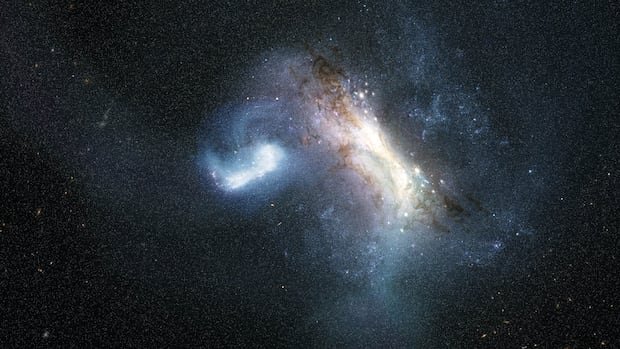

The Milky Way, a grand spiral galaxy housing billions of stars, including our sun, has undergone a complex journey to attain its present size, as outlined in recent research highlighting a significant event from its early history.
Researchers studying star clusters near the center of the Milky Way have found proof that our galaxy engulfed a smaller galaxy around 11.8 billion years ago, when the universe was only around 15 percent of its current age. This marks the earliest galactic merger known to have occurred in the Milky Way, showcasing how it expanded not only through its own star formation but also by merging with smaller galaxies pulled into its gravitational field.
The smaller galaxy, classified as a dwarf galaxy, was estimated to contain stars with a mass equivalent to 500 million times that of the sun at the time of the merger, approximately a quarter of the Milky Way’s size at that time.
Utilizing the Hubble and Gaia telescopes orbiting in space, the researchers analyzed stellar clusters within the innermost 20,000 light-years of the Milky Way, examining their age, chemical composition, and trajectory. A light-year, measuring 9.5 trillion kilometers, represents the distance light travels in a year.
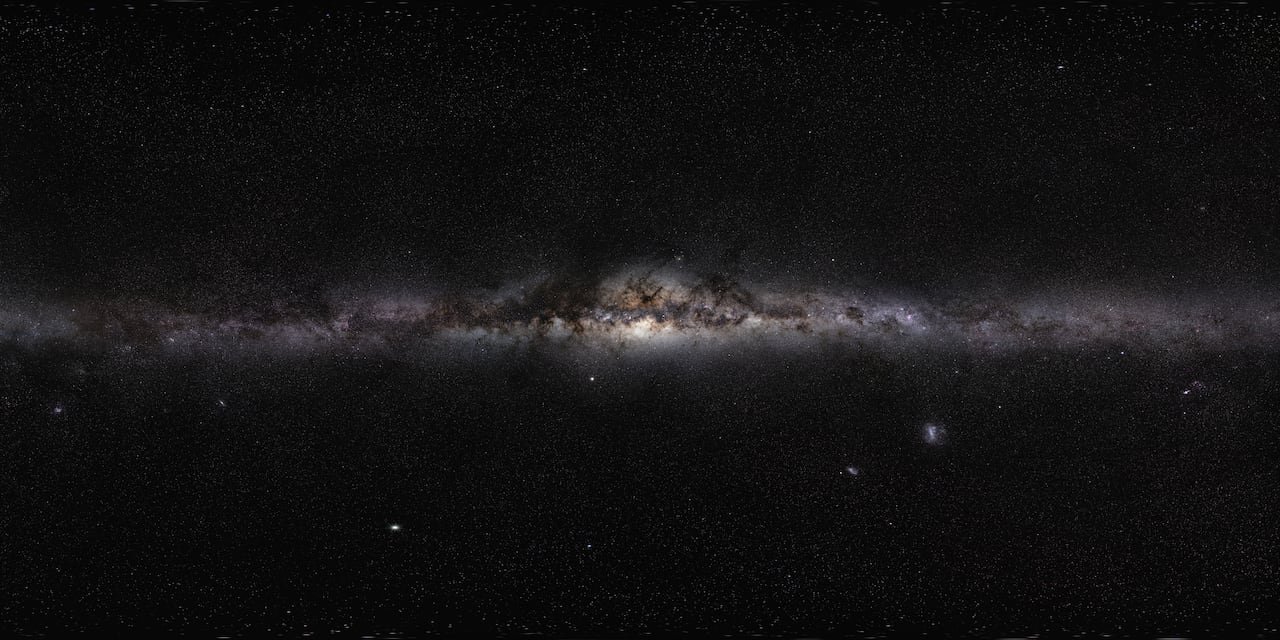
These stars became integrated into the Milky Way following a galactic merger that occurred roughly two billion years after the Big Bang, the event that marked the universe’s inception. The dwarf galaxy of origin was named Low-energy-Kraken-Heracles, or LKH, in reference to previous studies exploring the likelihood of such a primordial merger.
“The main discovery from our study is the clear identification of the initial merger experienced by our galaxy during its early stages,” stated lead author Davide Massari, an astrophysicist from the National Institute for Astrophysics in Bologna, Italy, whose findings were published in the journal Nature Astronomy.
‘Peaceful’ Merger
The debate over whether the Milky Way’s early expansion was driven by internal star formation or galactic mergers has persisted, according to Massari. The recent study suggests that the merger introduced a substantial amount of stars, interstellar gas supporting star formation, and dark matter into the Milky Way during its early phase.
“In terms of stars, the merger was relatively peaceful, with no star-on-star collisions. However, from a gas perspective, the merger was more ‘explosive’ — the interaction between the gas from LKH and that of the Milky Way likely triggered the formation of numerous stars,” noted Massari.