

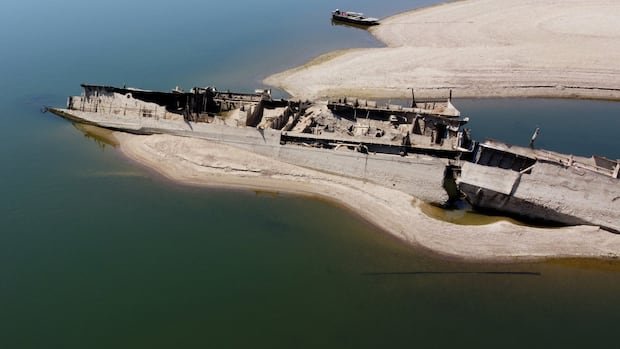

Nazi German warships that were purposely sunk in the Danube River during the Second World War are resurfacing due to plummeting water levels, highlighting the severe heat and drought affecting Europe this summer. This marks the fifth heatwave since May, with western Europe bracing for scorching temperatures, nearing 40 degrees Celsius in parts of Spain, France, and Italy. The Copernicus climate monitoring service for the European Union confirmed that June and July were the hottest on record in western Europe, contributing to approximately 25,000 heat-related deaths.
The intense heat has led to devastating wildfires and reduced water levels in crucial waterways like the Danube to record lows. Climate scientists emphasize that these exposed wrecks symbolize a broader issue: climate change driven by fossil fuels is exacerbating heatwaves and droughts, impacting wildfires, agriculture, shipping, and energy systems across Europe.
Historians estimate that up to 200 Nazi warships were scuttled near Prahovo, Serbia, in September 1944 to impede advancing Soviet forces. Now, due to the drying Danube, various unexpected relics are emerging, including a German military motorcycle in Hungary, an unexploded British bomb in Slovakia, and possible ancient mammoth remains in Bulgaria.
The diminishing water levels along the Danube have triggered urgent concerns for multiple countries along this river, which spans through ten countries before flowing into the Black Sea. Governments are implementing measures to cope with the water scarcity, such as restricting water usage for irrigation and ensuring the operation of vital facilities like nuclear power plants.
Experts warn that the current situation is a clear indication of climate change intensifying heat extremes, with heatwaves and droughts reinforcing each other. The significant rise in temperatures across Europe compared to historical averages underscores the urgency for sustainable environmental practices. The challenges posed by the drying Danube and extreme weather events serve as a stark reminder of the need to prioritize environmental conservation efforts to mitigate future climate-related crises.