

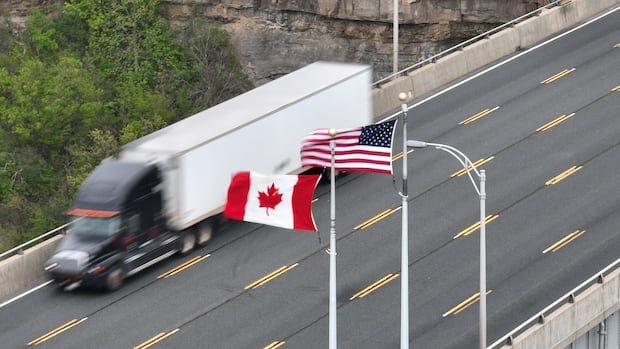

Amid ongoing trade discussions to avert additional U.S. tariffs, a recent report has cautioned about the potential consequences of the breakdown of the Canada-U.S.-Mexico Agreement, predicting significant job losses and economic repercussions on both sides of the border.
The report, commissioned by the Canadian American Business Council and conducted by Oxford Economics, an independent economic advisory firm, was unveiled on Monday. It assessed the potential outcomes of the current trade discussions between the U.S. and Canada.
The report outlined three scenarios: maintaining the existing tariffs, a scenario where the CUSMA agreement collapses, and a scenario where CUSMA is successfully renegotiated, leading to an improved trade relationship.
If CUSMA were to dissolve, the report projected job losses of approximately 214,000 in the U.S. and 102,000 in Canada compared to the status quo. Conversely, a successful renegotiation of CUSMA could result in job gains of 137,000 in the U.S. and 98,000 in Canada.
Beth Burke, CEO of the Canadian American Business Council, emphasized the significance of the trading relationship between the U.S. and Canada, stating that it directly impacts the prosperity of both nations.
The report also highlighted broader economic implications. In a breakdown scenario, the U.S. economy could lose $1.04 trillion USD and Canada $271 billion CAD by 2035. Inflation rates would likely rise in both countries, while real disposable income growth, especially in Canada, would be hindered.
Conversely, successful negotiations are projected to boost disposable income for citizens on both sides of the border, reduce inflation, and contribute billions to the GDP of both countries.

A report released on Tuesday by the Canadian American Business Council showcased the potential economic outcomes of different scenarios in CUSMA negotiations, with hundreds of thousands of jobs at stake in the ongoing trade talks. Power & Politics interviews Beth Burke, CEO of the Canadian American Business Council, on the significance of the discussions in Washington.
The report highlighted the impact on manufacturing industries in the worst-case scenario, specifically in auto, wood product, and metal product manufacturing sectors in the U.S., affecting states like Iowa, Michigan, Kentucky, and Alabama. Similarly, in Canada, Quebec and Ontario would bear the brunt in case of a breakdown, as manufacturing industries would suffer the most domestically.
Trade reps continue negotiations
The report’s release coincides with the looming deadline of August 19 for new 50% tariffs on various Canadian goods, constituting about 5% of Canada’s exports to the U.S.
Efforts are underway to reach a deal before the deadline to mitigate the imposition of new tariffs.