

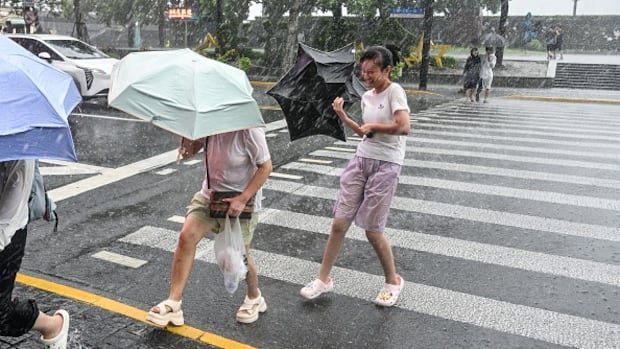

Shanghai airports were forced to cancel hundreds of flights on Monday due to the impact of tropical storm Dolphin, which brought heavy rainfall to eastern China. The storm had made landfall as a typhoon the previous day, causing flooding in various areas.
The Hongqiao and Pudong airports in Shanghai canceled over 900 flights, accounting for about 40% of the expected flights. This came after approximately 1,300 flights had been canceled the day before, as reported by the Shanghai Airport Group. Additionally, Shanghai suspended some metro lines, and China Railway Chengdu Group halted 115 trains.
Authorities issued warnings about potential severe flooding and landslides in certain regions. In Zhejiang province’s city of Yueqing, officials conducted search operations to rescue individuals trapped in flooded homes. The China Meteorological Administration stated that Dolphin was moving northwest at a speed of 15 to 20 kilometers per hour and was anticipated to weaken further.
Dolphin had made landfall in Taizhou, Zhejiang province, with wind speeds reaching 151 kilometers per hour on Sunday evening. Prior to reaching China, the storm had brought heavy rains to northern Taiwan. In Zhejiang’s Wenzhou, a video on TikTok showed a truck being overturned by powerful winds and rain, with the fate of the driver unknown.
Preemptive evacuations had been undertaken, with over 760,000 people relocated, including significant numbers in Taizhou, Shanghai, and Fujian province. Notably, Hangzhou in Zhejiang temporarily closed its iconic West Lake scenic spots, temples, parks, and museums for safety reasons.
Meanwhile, tropical storm Chan-hom was anticipated to move towards Japan’s Pacific coast, with wind speeds of 83 kilometers per hour on Monday. It was projected to strengthen slightly before its expected landfall between Tuesday and Wednesday, according to the Japan Meteorological Agency.
In Shanghai, some areas remained waterlogged, with residents sharing live streams on social media depicting knee-high murky water on the streets. This situation led to inconvenience for locals, with one resident, Hou Lina, expressing surprise at the widespread flooding caused by the typhoon.
As Dolphin continued its path inland, Beijing was bracing for significant rainfall, with authorities warning of potential flash floods and landslides. The typhoon’s extensive journey before making landfall had created an ultra-large cloud system that covered China’s eastern region, as reported by CCTV.
The impact of Dolphin was compared to the 2023 typhoon Doksuri, which caused substantial damage in Fujian province and record-breaking rainfall in Beijing. As the storm approached northern areas, Beijing, Tianjin, and Hebei were advised to prepare for heavy rainfall and potential flooding.
Apart from China, Dolphin indirectly contributed to severe weather in the Philippines, intensifying seasonal monsoon rains that triggered flooding and landslides. In Luzon, a mudslide in Baguio claimed 10 lives, adding to the toll from the week of heavy rains and floods in the region.
The forecast for the 2026 northwest Pacific typhoon season indicated high activity, with expectations of 28 tropical storms, 20 typhoons, and 13 intense typhoons. The strong El Niño event, increased activity, and weakened trade winds were cited as key factors contributing to the intensity of the typhoon season.