


There’s no reason to be concerned about the vampire camel.
For starters, this fanged creature has not inhabited the plains of present-day North America for approximately 12 million years.
Furthermore, despite boasting two rows of sharp teeth reminiscent of Dracula and its fearsome title, it was most likely a herbivore that feasted on leaves rather than a bloodthirsty monster.
“Unless you did something to provoke it, it wouldn’t harm you whatsoever,” stated paleontologist Donald Prothero during an interview with As It Happens host Nil Kӧksal. “We figured it deserved an appealing name.”

Donald Prothero, a paleontologist at California State Polytechnic University, Pomona, discusses Vampyrocamelus, commonly known as the vampire camel, with As It Happens host Nil Kӧksal.
Vampyrocamelus is one of five newly identified species detailed in an extensive monograph on the evolution of camels in North America, published in the New Mexico Museum of Natural History and Science Bulletins.
Researchers indicate that this discovery provides valuable insights into the Clarendonian epoch, a time when enormous predators and large herds of grazing mammals inhabited the savannah-like grasslands of what is now North America.
What is the purpose of those teeth?
The vampire camel existed around 12 to 13 million years ago in regions that are now Texas, Oklahoma, and Nebraska.
Only the male specimens displayed the prominent, curved fangs that inspired its name.
Despite these sharp front teeth, molars found among Vampyrocamelus fossils indicate that, like its relatives, it was a plant-eater.
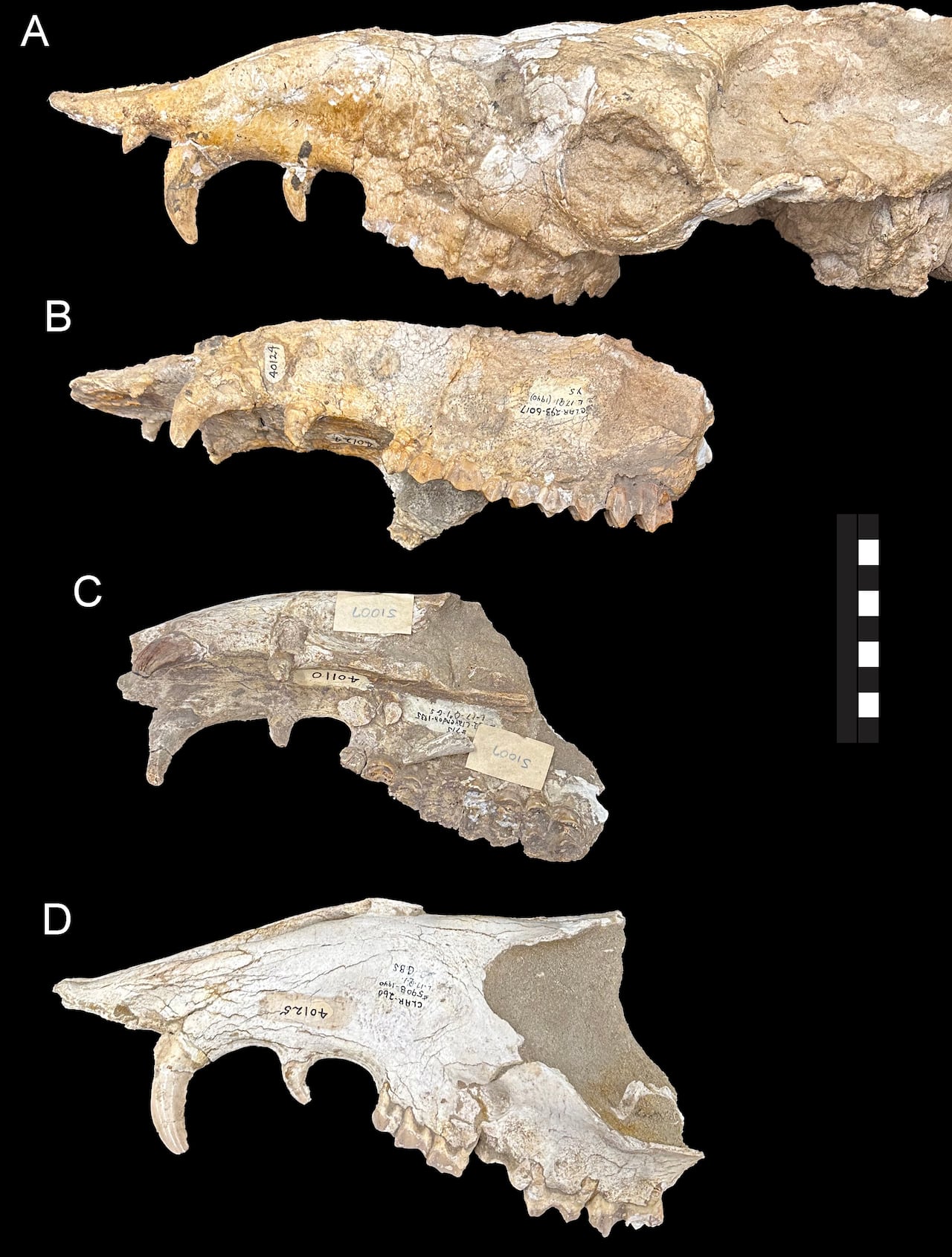
Fossils of Vampyrocamelus show two sets of curved canine teeth. (Donald Prothero)
So if those fangs weren’t meant for tearing into unsuspecting victims, what was their function?
“Male camels utilize their teeth to engage in confrontations with one another and bite until one asserts dominance, allowing him to become the sire of the next generation,” Prothero explained, who is also an adjunct professor at California State Polytechnic University, Pomona.
In fact, Prothero notes that it is typical for male camels to possess larger canines than their female counterparts. However, in contemporary species, these teeth appear more conical and less pronounced.
“Modern male camels often use their teeth to fight each other,” Prothero stated. “I’ve been informed that one of their common tactics in such conflicts is to bite each other’s testicles.”
Did camels inhabit North America?
Today’s camels are found in the deserts of Africa and Asia, as well as in the Andean mountains of South America. However, this was not always the case.
Prothero points out that camels originated in North America around 46 million years ago. Since 1982, he has dedicated himself to documenting all camel species found on the continent.
He and his team of colleagues and students have examined fossils from the Frick collection, which contains approximately 200,000 specimens spread over seven floors at the American Museum of Natural History (AMNH) in New York.
One entire floor is devoted to camels, according to Prothero, holding 20,000 specimens.
“It consists mainly of drawers filled with skulls, jaws, and limb bones,” Prothero mentioned. “Some of these specimens have been in the collection for a century without any thorough study.”
-
Meet the ‘hell chicken,’ a feisty little dinosaur who feasted on fruit
-
Newly discovered ancient apex predator had knife-sharp teeth and bone-crushing jaws
This is due to the fact that it was initially the private collection of millionaire Childs Frick.
Until Frick passed away in 1965, his collection was inaccessible to any researchers outside of his employment. It wasn’t until a decade later that the collection was relocated to New York and made available to scientists.
Prothero and his team meticulously examined that collection and classified 80 species of North American camels across 40 genera, including five species that are new to science, such as a long-snouted camel named Longirostrotylopus holroydae.
The researchers also eliminated 130 previously recognized species that are now deemed invalid based on new evolutionary insights.

Longirostrotylopus holroydae is a newly identified genus and species of long-snouted camel from the John Day Fossil Beds in Oregon. (Submitted by Donald Prothero)
Danielle Fraser, a paleobiologist at the Canadian Museum of Nature, expressed support for this new classification, including the vampire camel.
“If we don’t have an accurate count of the number of species, we risk missing essential patterns of evolutionary change,” Fraser, who was not part of the study, noted in an email.
“This monograph could enhance fossil databases utilized by various scientists to comprehend how mammalian faunas have evolved over time.”