

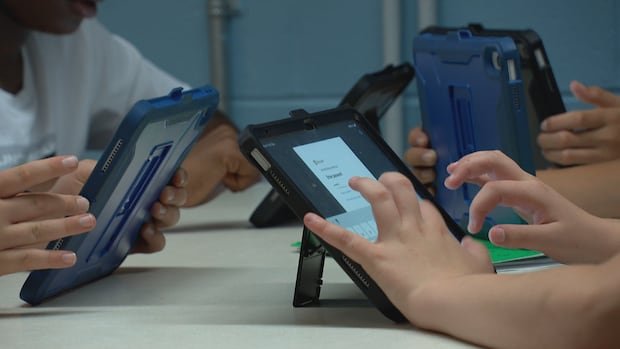

In a Moncton middle school this week, students embarked on a virtual adventure, aiming to escape from a dragon while delving into the realm of cybersecurity. Following this, some students shifted gears to create visual presentations, while others engaged with interactive screens to explore a unit on food. Additionally, a few students took on the challenge of programming small robots.
The middle schoolers, primarily Grade 7 students, were immersed in activities that incorporated artificial intelligence tools, all carefully overseen by their teacher. The Anglophone East School District has been progressively introducing AI into its educational framework over the past few years, with more schools in New Brunswick now following suit. This shift was prompted by the Department of Education’s integration of AI learning into the updated anglophone K-12 curriculum.
While some international school systems have recently imposed stringent restrictions on AI, such as Norway prohibiting most generative AI use among students up to Grade 7, New Brunswick is taking a different approach. The curriculum update in New Brunswick focuses on enhancing digital literacy by integrating structured AI components. This initiative is seen as a crucial step forward by experts like André Côté from The Dais at Toronto Metropolitan University, who highlights the need for education systems to address the influx of AI in schools effectively.
New Brunswick’s approach to AI education emphasizes age-appropriate instruction and critical thinking. Jordan Smith, the tech, innovation, and AI subject coordinator at Anglophone East, explained that students from kindergarten to Grade 2 are introduced to basic digital literacy concepts through discussions on technology use and information accuracy. As students progress, they engage with AI in a controlled manner, focusing on learning rather than direct interaction with advanced AI technologies.
The approved list of AI platforms for school use includes tools like the Microsoft chatbot Copilot and creative platforms like Canva and Suno. Students in high school may leverage AI tools for tasks like generating book recommendations or analyzing their writing. However, the emphasis remains on using AI as a supportive tool rather than a replacement for personal effort.
Teachers in the district are undergoing professional development to effectively integrate AI into their teaching practices. The province has also rolled out AI learning modules for educators. Education Minister Claire Johnson emphasized the importance of incorporating safe and ethical AI use in schools while maintaining a strong foundation in literacy and numeracy.
Randolph MacLean, the Superintendent of Anglophone East, described the process of integrating AI into schools as a collective effort that requires ongoing evaluation and collaboration between schools and families. Despite some concerns raised by parents, the district ensures transparency by providing digital consent forms for AI tool usage.
The growing debate around AI in schools has sparked a wave of parental concern, with some advocating for a cautious approach. Ben Humphreys, a parent and co-founder of Parents for AI Caution in Schools in Vancouver, highlights the need for responsible AI integration and calls for a pause in introducing AI technologies in the classroom.
Educators and parents alike are expressing reservations about the rapid adoption of AI in schools. Clint Johnston, the president of the Canadian Teachers’ Federation, stresses the importance of proper support and training for educators to navigate the evolving landscape of AI in education.
A recent survey by KPMG Canada revealed a significant gap between student and educator readiness for AI integration. Rob Clayton, KPMG Canada’s education leader, emphasized the need for clear policy guidance to ensure responsible AI use in educational settings.
Experts like André Côté from The Dais advocate for a coordinated approach at the national level, drawing on best practices and research from global organizations. They stress the importance of addressing complex issues like assessment and data privacy to effectively navigate the transformative impact of AI in education.