

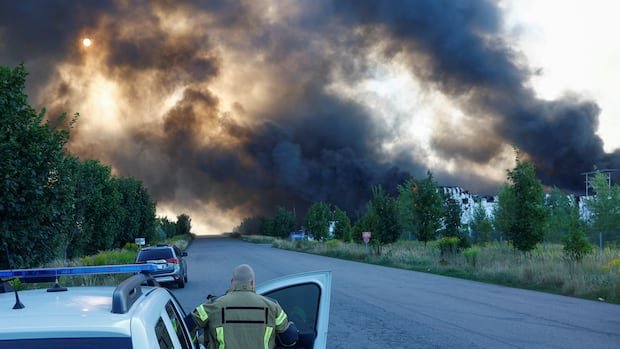

Russia launched a heavy bombardment on Kyiv, Ukraine, and its nearby areas using numerous missiles and drones during a nighttime aerial assault that continued for several hours, resulting in the deaths of at least 16 individuals, officials confirmed on Thursday.
The Russian military has escalated its ballistic missile attacks on Kyiv in recent months, taking advantage of Ukraine’s limited supply of U.S.-made Patriot air defense interceptors, the only system capable of intercepting ballistic missiles in Ukraine’s arsenal.
President Volodymyr Zelenskyy of Ukraine has appealed for more Patriot interceptors from other countries, but global stockpiles are low due to ongoing conflicts like the Iran war and Ukraine’s prolonged battle against Russia’s full-scale invasion.
The overnight assault by Russia included not only ballistic missiles but also cruise missiles and high-speed jet-powered drones, further straining Ukraine’s air defenses, according to the Ukrainian air force.
Explosions resonated throughout the darkened city, with Kyiv being the main target; however, impacts were recorded in 28 locations across the country, as reported by the air force. Zelenskyy mentioned that around 40 individuals were injured, while air raid alerts remained active until dawn.
Zelenskyy described the attack as “massive” on social media, stating that Russia had meticulously planned it for an extended period, using a variety of ballistic missiles, cruise missiles, and drones to inflict maximum damage on civilian infrastructure.
Meanwhile, the Russian Defence Ministry claimed that the assault hit an industrial site in Kyiv responsible for manufacturing components for Ukraine’s Flamingo cruise missiles, as well as sites involved in drone production and storage, an ammunition depot, and a logistics center.
As the attack unfolded, the Polish Armed Forces Operational Command activated military aviation operations, ground-based air defense systems, and radar reconnaissance. Polish and other NATO military aircraft were deployed to monitor the country’s airspace, as reported by the Polish news agency PAP.
Romania’s Defence Ministry reported that an unidentified drone crashed and caught fire in an uninhabited area near the Ukrainian border. Additionally, Spanish F-18 jets were scrambled in Romania to monitor “air targets” near the border, and an unauthorized drone breached Moldova’s airspace.
Ukrainian Foreign Minister Andrii Sybiha highlighted on social media that Russia’s actions were testing NATO’s commitment while violating neighboring states’ sovereignty and escalating risks beyond Ukraine’s borders.
Despite the challenges, Ukraine’s quest for missile defense systems continues. The Associated Press analysis revealed a significant decrease in U.S. Patriot inventory post-war, though efforts are being made to enhance production capacity. Lockheed Martin aims to increase annual interceptor production to 2,000 by 2030.
The political landscape has also seen shifts, with previous promises of providing Ukraine with Patriot production licenses facing uncertainties. Russia’s overnight strikes resulted in significant damage to residential areas in Kyiv, with multiple locations affected and emergency crews working to rescue individuals trapped under debris.
As the conflict between Russia and Ukraine intensifies, both sides have engaged in drone and missile attacks, with neither able to gain a decisive advantage along the 1,250-kilometer front line. Ukraine has attempted to retaliate by targeting Russian oil facilities through drone strikes, with the Russian Defence Ministry reporting the downing of 726 Ukrainian drones in various regions without any immediate reports of damage or casualties.