

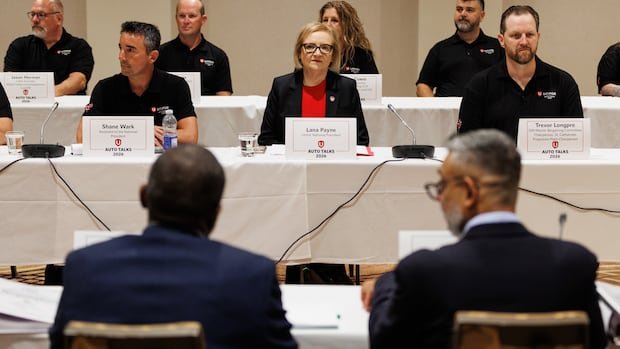

Unifor and General Motors have initiated talks for a new labor agreement, commencing negotiations at a central Toronto bargaining location. The union represents over 4,600 members across various Ontario GM facilities, including the Oshawa assembly plant, the CAMI facility in Ingersoll, as well as operations in St. Catharines and Woodstock. Lana Payne, the Unifor national president, and Jack Uppal, the president and managing director at GM Canada, officially began discussions with a handshake.
The negotiation room was set up with chairs positioned in a way that officials sat on opposite ends, with Payne situated in the middle and Uppal directly across. Payne expressed optimism, stating, “We’re approaching this next phase of negotiations with a strong foundation set by the pattern agreement with Ford. We aim to engage in meaningful discussions regarding company operations and the future of automotive jobs at GM in Canada.” Unifor has set a target deadline of August 21 to reach a preliminary agreement with GM.
In a news release, Uppal mentioned that GM enters negotiations with a deep respect for the collective bargaining process and the significant role its employees play in the company’s accomplishments. He emphasized GM’s substantial investments in Canadian manufacturing plants since 2020, totaling $3.3 billion, to facilitate next-generation products that will secure thousands of Canadian jobs long-term. The company’s objective is to achieve a mutually beneficial agreement that supports employees while ensuring GM Canada’s competitiveness in the future.
Earlier in July, Unifor members approved a new three-year contract with Ford, which includes annual pay increases of three percent. The agreement also extends a no-closure commitment and outlines program commitments at all Ford facilities, such as the introduction of a third shift at its engine plant in Essex, Ont., projected for 2029.
Unifor and Ford have also collaborated on a program designed to assist laid-off workers from Ford’s Oakville assembly plant in transitioning to full employment by July 2027. Unifor hailed the agreement with Ford as a successful pattern-setting negotiation, where terms set with one company are intended to be replicated with others in the same sector. The master agreement was supported by 74% of Ford workers, with local members voting 97% and 100% in favor.
Although recognizing differences between Ford and its counterparts like General Motors and Stellantis, Unifor’s Lana Payne anticipates challenging negotiations ahead. She pointed out that General Motors’ Ingersoll assembly plant and Stellantis’ Brampton assembly plant are currently inactive, leading to significant layoffs. Payne acknowledged the potential complexity of upcoming talks due to varying decisions made by different automakers throughout recent trade uncertainties.
The ongoing negotiations between Unifor and the remaining Detroit Three automakers coincide with sector challenges, including U.S. tariffs, trade agreements, and the emergence of Chinese electric vehicles in the Canadian market.