


President Donald Trump has issued a warning to potentially utilize the US military to address demonstrations in Minnesota by evoking the Insurrection Act in order to halt the ongoing unrest.
The seldom-used Insurrection Act grants the President the authority to deploy military forces within the country to quell rebellion or violence. This act enables the President to circumvent state governors and local officials and dispatch National Guard troops from other regions to Minnesota. The escalating situation in Minnesota could potentially warrant the invocation of this act, although resorting to the military against American civilians would signify a significant escalation. The most recent use of the Insurrection Act was under George W. Bush’s administration to suppress the 1992 LA riots.
Lyndon B Johnson employed this act twice during the 1960s – once to suppress riots in Detroit and again amidst unrest following the assassination of Martin Luther King Jr. Historically, it has only been activated in a limited capacity and solely to address specific instances of violence or unrest that law enforcement might struggle to control. Trump, in a post on Truth Social, stated: “If the corrupt politicians in Minnesota fail to uphold the law and prevent agitators and insurrectionists from targeting ICE Patriots who are simply carrying out their duties, I will implement the INSURRECTION ACT, a measure adopted by many of my predecessors, to swiftly put an end to the chaos unfolding in that once esteemed state.”
Trump has repetitively alleged – without substantiation – that protests against ICE operations in Minnesota are “fabricated” and that the participants are “professionals.” This narrative aligns with a conspiracy theory his administration has propagated, suggesting that any dissent or protest against him is orchestrated, organized, and funded by a clandestine network of “radical leftist” individuals. Trump has previously threatened to invoke the act following demonstrations in Portland and Los Angeles. The Department of Homeland Security has reported over 2,000 arrests in Minnesota since early December, but has faced widespread criticism for targeting lawful protesters.
Minneapolis Mayor Jacob Fray described the current situation as unsustainable. He remarked, “Our city is currently in an untenable position where we are striving to safeguard our citizens, protect our community, and uphold order while seeking a path forward.” Fray expressed concerns that the federal presence, exceeding the city’s 600-officer police force fivefold, has “invaded” Minneapolis, causing fear and outrage among residents.
The President’s declaration follows a recent incident where a federal immigration officer shot and injured a Minneapolis resident who had assaulted the officer with a shovel and broom handle. This event has further intensified the apprehension and anger prevailing in the Minnesota city since the fatal shooting of Renee Good by an Immigration and Customs Enforcement agent.
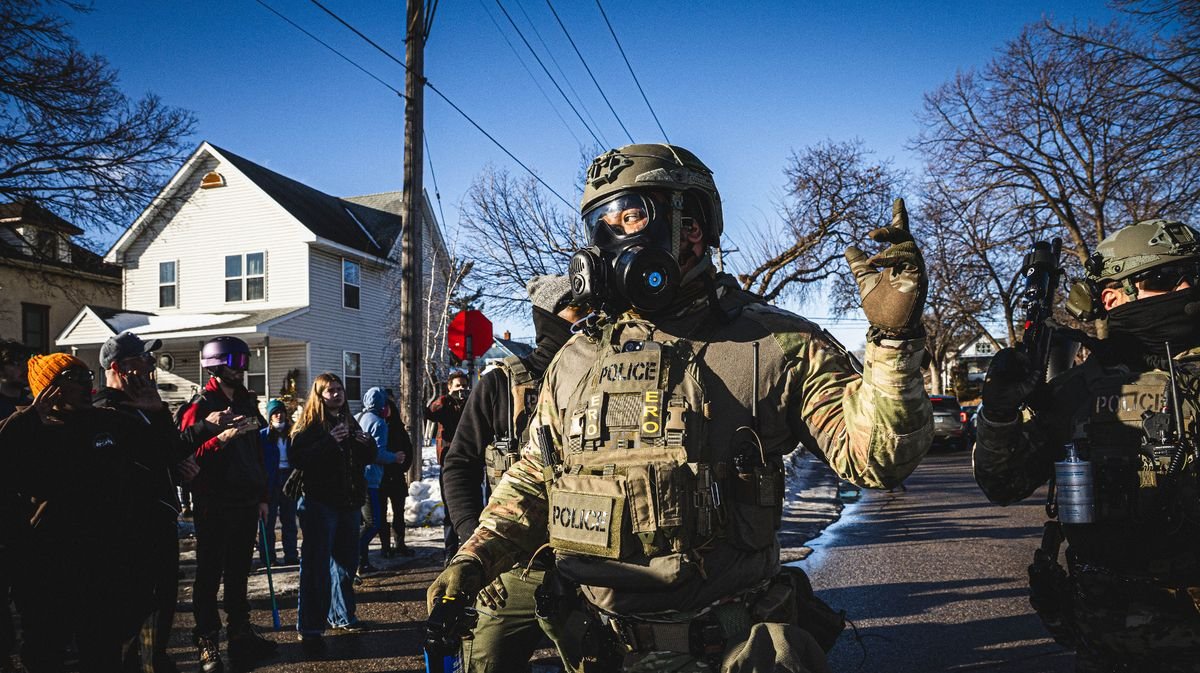
In Minneapolis, unrest unfolded on Wednesday night near the scene of the latest shooting as federal officers, outfitted in gas masks and helmets, dispensed tear gas into a small assembly. In response, protesters retaliated by hurling rocks and launching fireworks.
During a press briefing, Police Chief Brian O’Hara declared the gathering as an unlawful assembly and urged individuals to disperse.
Situation later de-escalated, and by early Thursday, only a handful of demonstrators and law enforcement personnel remained at the location.
Protests have become routine in the streets of Minneapolis since the fatal shooting of 37-year-old Good by an ICE agent on January 7. Agents have forcibly removed individuals from their vehicles and residences, facing opposition from incensed bystanders demanding their departure.